
In this post, I wanted to outline and compress all of my academic research into a streamlined format. My research has focused mostly on compositionality in formal systems, neural systems, and artificial systems, with common themes being the nature, acquisition, evolution, and implementation of higher-order structure-building in the human mind/brain.
In 2024, I developed a neurocomputational architecture for natural language syntax (“ROSE”), explored ways to extend this model into a hybrid symbolic-connectionist framework, proposed a design principle for human syntax (“Turing-Chomsky Compression”), mapped multiple dimensions of syntactic structure using direct cortical recordings, and tested compositional processing in LLMs. Here, I outline how my prior and future research has been (and is being) informed by these ideas.
In general, I have a broad teaching, training and publication background in linguistics, philosophy of mind, philosophy of language, cognitive science, machine learning, theoretical and experimental neuroscience, experimental psycholinguistics, and political philosophy.
Academic Career
My undergraduate degree (BA, English – First-class honors) moved me from my home town of Liverpool to the University of Nottingham, and culminated in a thesis project examining modern cases of English fiction that explored ideological threads connected to egalitarian and democratic ideologies. I conducted research into the philosophy of language in Joyce, Wilde, Coetzee, Shakespeare and John Cowper Powys, amongst others. This thesis was subsequently published as a book a year later by a philosophy publishing house (Zer0 Books). I also became exposed to debates between semantic externalists and internalists, principally through the works of Russell, Kant, Kripke, the Strawsons, and Chomsky.

After graduation, I decided to pursue Linguistics at UCL, but with a commitment to keep involved via publications and collaborations with the core philosophical issues I have always seen as being at the core of my empirical and theoretical research – across the humanities and sciences. As mentioned above, later in my career these philosophical interests would eventually crystallize into a focused research program into compositionality in formal, psychological, artificial, and neural systems.

At UCL, my MA (Linguistics), MSc (Language Sciences with Neuroscience) and PhD (Linguistics) degrees were all awarded from the Department of Linguistics. I was also awarded an ERSC ‘1+3’ scholarship to fund my MSc and PhD. My MA thesis explored which format of mental representations for language are relevant to informing debates about language evolution. My MSc thesis reported an eye-tracking study investigating aspects of syntactic parsing (specifically, ‘island’ effects during reading). My PhD thesis probed the formal, representational properties of complex polysemy in copredication, critical to current debates in internalism, reference, and models of lexical storage. I also conducted a number of behavioural (acceptability judgment) and parsing (EEG) experiments to map the processing of complex polysemy to test various psycholinguistic models at the semantics and pragmatics interface.
For my postdoctoral training, I moved to the United States to work in the Tandon Lab in Houston, Texas, conducting experiments using direct cortical recordings to probe the spatiotemporal neural dynamics of language, meaning, attention, and – in more recent years – consciousness. A major focus has been the neural basis of compositionality and syntactic processing. My research here has revealed the likely site of the core language network responsible for compositional, hierarchical syntax: lateral posterior superior temporal sulcus.

Overall, my research has had implications for the way we theorize about the sub-components of symbolic and abstract thinking, in particular at the neural level, but also at the level of computational modelling. One of my most recent research projects concerns the development of a hybrid model for compositionality in minds and neural systems, leveraging the strengths of both symbolic and connectionist approaches.
Academic Contributions
The cognitive science of symbolic thinking and natural language involves using data to develop statistical models, task models (models of human behaviour) and models of causal mechanisms that give rise to data in the first place. These approaches are always informed by philosophical assumptions, and have implications for the way we understand human language and its place in nature. My goal has been to make contributions to all of these domains, in the following way.
My combination of philosophical and empirical research has allowed me to expand beyond my early career focus on the electrophysiology of semantic processing, to questions regarding language acquisition, language deficits, neurological disease states, and artificial intelligence and deep neural network models. My research continues to be highly interdisciplinary, covering psycholinguistics, language development, philosophy of mind, genetics of language, artificial intelligence and systems neuroscience.
I also regularly write book reviews and engage in current debates in philosophy and cognitive neuroscience in popular venues. Some major books I have reviewed include Definite Descriptions (Paul Elbourne), Reflections on Language Evolution (Cedric Boeckx), The Human Mind Through the Lens of Language: Generative Explorations (Nirmalangshu Mukherji), The Intellectual Life of the British Working Classes (Jonathan Rose), Class and Contemporary British Culture (Anita Biressi and Heather Nunn), After Occupy: Economic Democracy for the 21st Century (Tom Malleson), Unhitched: The Trial of Christopher Hitchens (Richard Seymour), and Original Spin: Downing Street and the Press in Victorian Britain (Paul Brighton). I have also contributed a number of articles to popular magazines on a range of philosophical and ethical issues, mostly focused on human rights and international relations.
My current postdoctoral position has focused on using intracranial EEG to explore questions in the cognitive science of language, attention, consciousness, music and semantics. I have used sEEG, subdural arrays and direct cortical stimulation mapping to expose the causal involvement of brain regions in cognition. I explore compositionality in neural systems as a means to test a more general hypothesis concerning how cognitive computation is orchestrated across transient, distributed and overlapping networks.
In the following sections, I include below each topic relevant citations to my published research, which you can find on Google Scholar.
Contributions to Philosophy
My research within philosophy has focused on a broad range of topics. I have defended semantic internalism against its critics, with particular emphasis on ‘regular’ polysemy, container concepts, and institutional entities. This philosophy of language and mind forms the foundation of all of my past academic research reported below.
• Murphy, E. (2014). Review of Definite Descriptions by Paul Elbourne. The Linguistic Review 31(2): 435–444.
• Murphy, E. (2023). The citadel itself: defending semantic internalism. Global Philosophy 33: 7.
• Murphy, E. (2025). The nature of language and the structure of reality. In Benítez-Burraco, A., López, I.F., Férnandez-Pérez, M., & Ivanova, O. (eds.), Biolinguistics at the Cutting Edge: Promises, Achievements, and Challenges. Berlin: De Gruyter Mouton.
I have explored debates concerning the communicative vs. cognitive function of natural language syntax, arguing for its principal role in organizing compositional reasoning.
• Murphy, E. (2020). Language design and communicative competence: the minimalist perspective. Glossa: A Journal of General Linguistics 5(1): 2.
I have explored in both theoretical and empirical papers the limitations of current Large Language Models (LLMs) and text-to-image models (DALL·E 2/3) to parse different forms of compositional structures. In concert with Gary Marcus, Jill de Villiers, Evelina Leivada and others, I have probed a number of leading LLMs for their ability to assess and produce structures adhering to basic principles of hierarchical, recursive, and compositional generation. The general theme here has been to formally characterize, and experimentally probe, the abilities of artificial language models, with a focus on syntactic, semantic and pragmatic competence.
• Murphy, E., & Leivada, E. (2022). A model for learning strings is not a model of language. Proceedings of the National Academy of Sciences of the United States of America 119(23): e2201651119.
• Marcus, G., & Murphy, E. (2022). Three ideas from linguistics that everyone in AI should know. Marcus on AI (Substack). 22 June.
• Leivada, E., Murphy, E., & Marcus, G. (2022). DALL·E 2 fails to reliably capture common syntactic processes. Social Sciences & Humanities Open 8(1): 100648.
• Dentella, V., Günther, F., Murphy, E., Marcus, G., & Leivada, E. (2024). Testing AI on language comprehension tasks reveals insensitivity to underlying meaning. Scientific Reports 14: 28083.
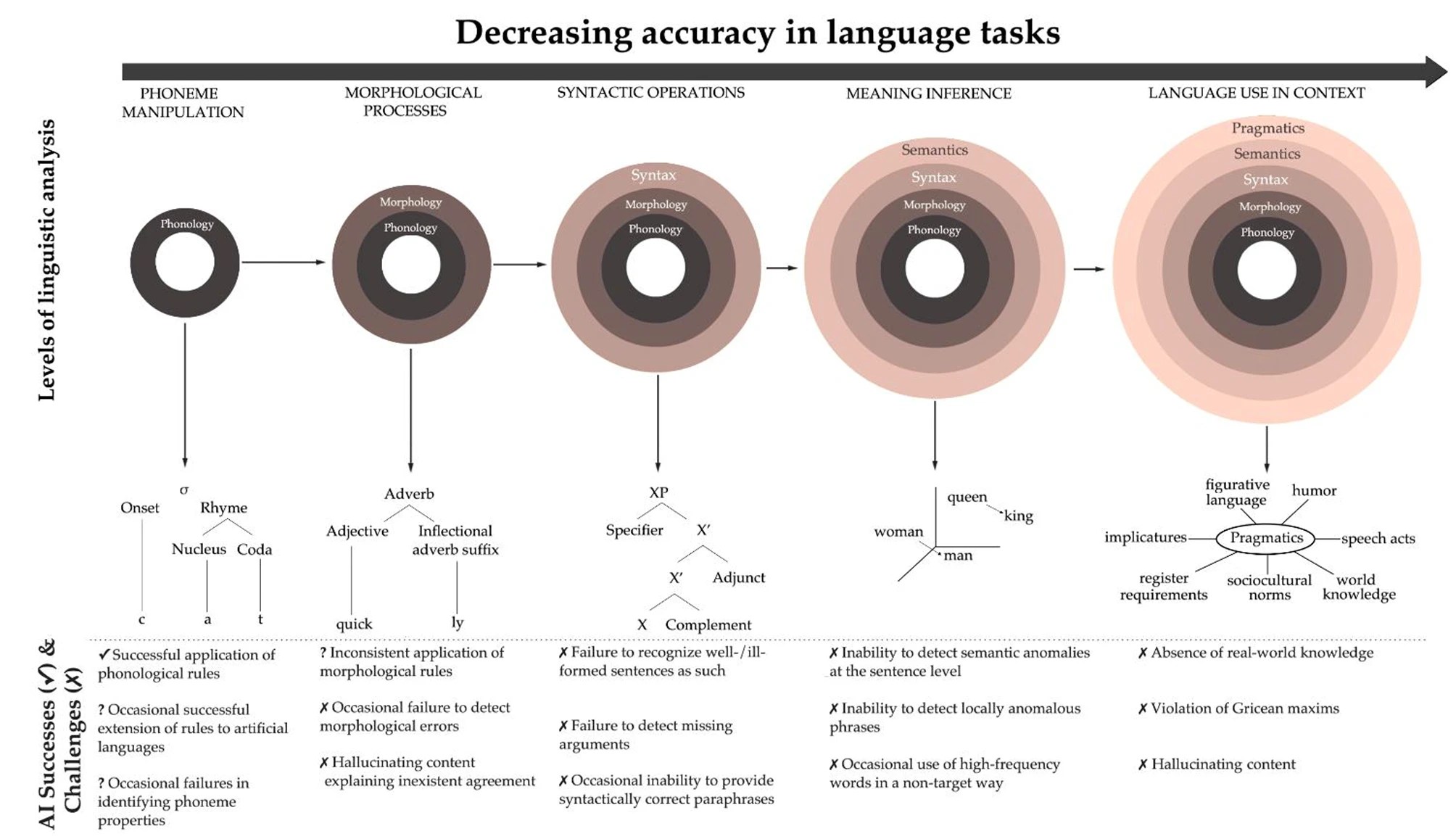
• Leivada, E., Marcus, G., Günther, F., & Murphy, E. (2024). A sentence is worth a thousand pictures: can large language models understand hum4n l4ngu4ge and the w0rld behind w0rds? arXiv:2308.00109.
• Leivada, E., Dentella, V., & Murphy, E. (Forthcoming). The quo vadis of the relationship between language and large language models. In Mendívil-Giró, J.L. (ed.), Artificial Knowledge of Language: A Linguists’ Perspective on its Nature, Origin and Use.
• Murphy, E., de Villiers, J., & Morales, S.L. (In revision). A comparative investigation of compositional syntax and semantics in DALL·E and Young Children.

Progressing on from this research, I have proposed a number of reasons for why artificial language models cannot be said to ‘refer’ to entities in the world. This dovetails into my broader appeal to internalist approaches to the philosophy of mind.
• Baggio, G., & Murphy, E. (2024). On the referential capacity of language models: an internalist rejoinder to Mandelkern & Linzen. arXiv:2406.00159.
In theoretical work synthesizing much of this research, I provide a hybrid framework for compositional reasoning and structure-building based on what properties of cognitive processing (compositional, relational, abstraction, etc.) LLMs appear able (and not able) to perform. This relates to my interest (below) in integrating perspectives on compositionality across frameworks, in particular with respect to grounding symbolic and sub-symbolic theories in a neurobiologically plausible infrastructure. I have leveraged these perspectives to inform a broader philosophy of language, and an architecture for the neural representation of language.
• Murphy, E. (2024). Shadow of the (hierarchical) tree: reconciling symbolic and predictive components of the neural code for syntax. arXiv:2412.01276.
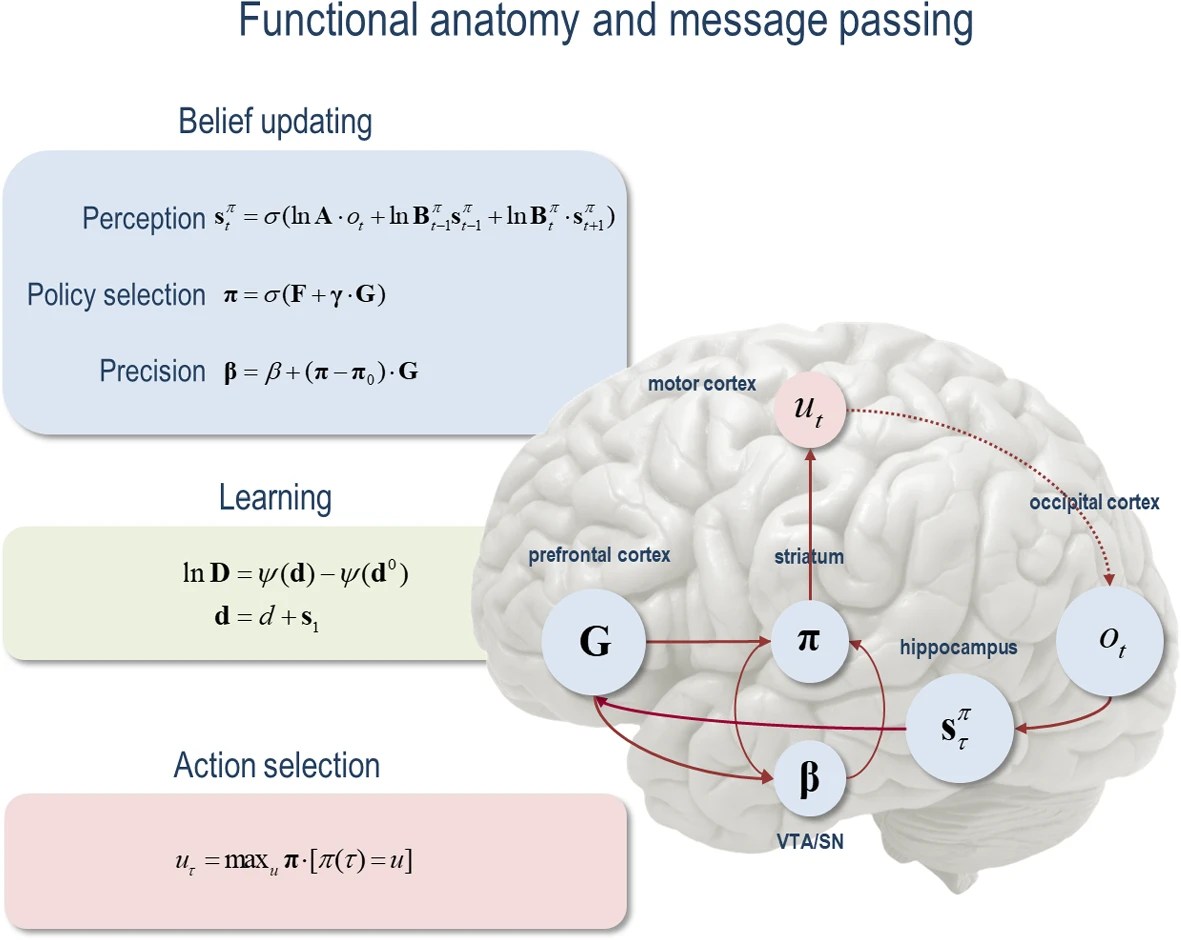
I recently proposed a means to ground principles from theoretical linguistics within the free-energy principle and active inference framework, in collaboration with Emma Holmes and Karl Friston. This forms part of an effort within my research to migrate concerns from linguistics to a cognitively and neurobiologically plausible framework amenable to computational cognitive modelling and further neurobiological investigation.
• Murphy, E., Holmes, E., & Friston, K. (2024). Natural language syntax complies with the free-energy principle. Synthese 203: 154.

I have explored some philosophical implications of the above frameworks, specifically in relation to how Nietzsche’s philosophy of mind can help explain particular aspects of his political thought. I also continue to engage in literary criticism of writers who seem to align with various of these philosophical themes (e.g., John Cowper Powys, David Foster Wallace, James Joyce).
• Murphy, E. (2013). Joyce on nationality, language, and religion. Innervate 5: 39–45.
• Murphy, E. (2015). The politics of sorrow. OpenDemocracy. 31 August.
• Murphy, E. (2018). Anarchy and identity: on power and loneliness in the works of John Cowper Powys. The Powys Journal 28: 120–139.
• Murphy, E. (2023). Animals sick with language: from syntax to socialism in Nietzsche. In McManus, M. (ed.), Nietzsche and the Politics of Reaction: Essays on Liberalism, Socialism, and Aristocratic Radicalism. Palgrave Studies in Classical Liberalism. Palgrave Macmillan. 263–286.
I retain an active research focus on the philosophical implications of polysemy, and the psycholinguistic properties of copredication (see next section) and related topics, engaging in ongoing philosophical exchanges over these issues.
• Murphy, E. (2023). Copredication and complexity revisited: A reply to Löhr and Michel. Cognitive Science 46(10): e13207.
• Murphy, E. (2024). Predicate order and coherence in copredication. Inquiry 67(6): 1744–1780.

• Murphy, E. (2024). The paper was boring and long: A reply to Michel and Löhr’s theory of predicate ordering in copredication. PsyArXiv: doi/10.31234/osf.io/f9cv7.
I have discussed the philosophical consequences of a Merge-based syntax for natural language, through a Cartesian lens, following some traditional ideas that the principles of linguistic theory do not simply form a part of mental life – they directly characterize the central format of the human mind.
• Murphy, E. (2023). A future without a past: philosophical consequences of Merge. Biolinguistics 17: e13067.
The notion of ‘wordhood’ and lexicality is critical to carving out linguistic from non-linguistic contributions to mental life, and I have attempted to define these concepts more precisely than many existing models of lexical knowledge.
• Murphy, E. (2024). What is a word? arXiv:2402.12605.

In summary, my core interests in philosophy generally centre around the architecture of the language system, its interface with other cognitive systems, and putative consequences of this for the thought and ideology of major thinkers in the field.
Contributions to Cognitive Science
My doctoral research focused on the representational and processing properties of complex polysemy permitting forms of ‘copredication’, whereby contradictory senses can be attributed to a single nominal (e.g., “The newspaper that was on the table reported on the recent scandal”). This research revealed a robust acceptability bias (Incremental Semantic Complexity), whereby the semantic complexity of the senses influenced the order of their acceptable presentation, such that semantically simpler senses (i.e., physical entities) preceding more complex senses (e.g., institutional entities; events) is typically considered more acceptable than the reverse order. This research was used to support a One Representation Hypothesis model of lexical representations for polysemous entities. I leveraged these results to support my internalist critiques of accounts of polysemy that postulate various extensions for complex nominals.
• Murphy, E. (2019). Acceptability properties of abstract senses in copredication. In Bolognesi, M., & Steen, G. (eds). Perspectives on Abstract Concepts: From Cognitive Processing to Semantic Representation and Linguistic Expression. Human Cognitive Processing Series. Amsterdam: John Benjamins. 145–165.
• Murphy, E. (2021). Linguistic Representation and Processing of Copredication. PhD thesis, University College London.
Following this, I conducted an experiment probing topics in psychological essentialism for polysemous institutional concepts – premised on the idea that institutional concepts are some of the most complex cognitive representations, but among the least experimentally investigated. I discovered that the polity-type or organization-type sense typically determined ‘sensehood’ for these nominals, and not other components of meaning like physical features or spatiotemporal contiguity.
• Murphy, E. (2021). Persistence conditions of institutional entities: Investigating copredication through a forced-choice experiment. Frontiers in Psychology 12: 528862.
When examining some of the core consequences of modern theoretical linguistics, I have emphasized the role of syntactic ‘labeling’ in delivering recursive hierarchical structure-building for language, a major component of mental life.
• Murphy, E. (2015). Reference, phases and individuation: topics at the labeling-interpretive interface. Opticon1826 17(5): 1–13.
• Murphy, E. (2015). Labels, cognomes, and cyclic computation: an ethological perspective. Frontiers in Psychology 6: 715.
• Murphy, E., & Shim, J.-Y. (2020). Copy invisibility and (non-)categorial labeling. Linguistic Research 37(2): 187–215.

Following this syntax-centric philosophy, I have argued that certain pragmatic processes invoking ‘unarticulated constituents’ are always optional, and not obligatory during sentence comprehension, when we consider that syntactic instructions are often more than sufficient to deliver particular interpretations of complex sentences. This undermines the need to postulate a rich pragmatic system. I argued that grammatical expressions are propositionally whole and psychologically plausible, leading to the explanatory burden being placed on syntax rather than pragmatic processes.
• Murphy, E. (2016). Phasal eliminativism, anti-lexicalism, and the status of the unarticulated. Biolinguistics 10: 21–50.

As well as conducting a child language processing experiment documenting the development of complex polysemy, I have made some theoretical contributions to the language acquisition literature through proposing a biologically plausible model of grammatical development, moving beyond the more classical generative frameworks that have dealt poorly with the topic of learnability.
• Murphy, E. (2017). Acquiring the impossible: developmental stages of copredication. Frontiers in Psychology 8: 1072.
• Leivada, E., & Murphy, E. (2022). A demonstration of the uncomputability of parametric models of language acquisition and a biologically plausible alternative. Language Development Research 2(1): 105–138.

I have argued that syntactic labeling, and the categorization of hierarchical linguistic sets, is the major evolutionary novelty afforded by the emergence of language.
• Murphy, E. (2014). Computation and Continuity in the Evolution of Grammar. Master’s thesis. University College London.
• Murphy, E. (2016). Evolutionary monkey oscillomics: generating linking hypotheses from preserved brain rhythms. Theoretical Linguistics 42(1–2): 117–137.
• Murphy, E., & Benítez-Burraco, A. (2018). Paleo-oscillomics: inferring aspects of Neanderthal language abilities from gene regulation of neural oscillations. Journal of Anthropological Sciences 96: 111–124.
• Murphy, E., & Benítez-Burraco, A. (2018). Toward the language oscillogenome. Frontiers in Psychology 9: 1999.

• Murphy, E. (2019). No country for Oldowan men: emerging factors in language evolution. Frontiers in Psychology 10: 1448.
• Benítez-Burraco, A., Zaccarella, E., & Murphy, E. (2023). The evolution of the brain hardware for language. Frontiers in Psychology 14: 1323737.
Lastly, I have navigated some spaces of technical ambiguity in the literature to try and resolve conflicting claims and research directions. For instance, this has resulted in a discussion of misused, ambiguous or polysemous technical terms in the cognitive science of language.
• Leivada, E., & Murphy, E. (2021). Mind the (terminological) gap: 10 misused, ambiguous, or polysemous terms in linguistics. Ampersand 8: 100073.
In summary, much of my research in cognitive science has focused on theoretical issues concerning the place of syntactic structures in the cognitive architecture of humans, and experimental issues concerning the processing properties of complex forms of polysemy underlying many classical paradoxes and philosophical controversies.
Contributions to Cognitive Neuroscience
As with the above research sections, my contributions to cognitive neuroscience can be split into empirical and theoretical themes. Using direct intracranial EEG recordings from penetrating depth electrodes in epilepsy patients, my recent experimental research has focused on compositionality in neural systems, revealing that lateral posterior temporal cortex exhibits the earliest sensitivity to compositional phrase structure and hierarchical morphosyntax, independent of lexical information.
My intracranial research has supported a critical role for posterior temporal regions in the processing of hierarchical phrase structures (Murphy et al. 2022, Journal of Neuroscience), hierarchical melodic structures (McCarty et al 2023, iScience), complex sentence representations in reading (Woolnough et al 2023, PNAS) and listening (McCarty et al 2023, iScience), and the integration of multiple types of syntactic (Murphy et al 2024, Progress in Neurobiology) and semantic (Murphy et al 2023, Nature Communications) information.
This research helped me uncover a cortical mosaic for linguistic structure spreading from posterior superior temporal sulcus to neighboring cortical sites, whereby electrodes sensitive to phrase structure did not display sensitivity to lexicality, but were closely abutting these sites, providing a structured neural tessellation for compositionality in natural language syntax-semantics.
• Murphy, E., Woolnough, O., Rollo, P.S., Roccaforte, Z., Segaert, K., Hagoort, P., & Tandon, N. (2022). Minimal phrase composition revealed by intracranial recordings. Journal of Neuroscience 42(15): 3216–3227.

• Murphy, E., Rollo, P.S., Segaert, K., Hagoort, P., & Tandon, N. (2024). Multiple dimensions of syntactic structure are resolved earliest in posterior temporal cortex. Progress in Neurobiology 241: 102669.

I have made other contributions to the neurobiology of sentence reading, tracking the neural signatures of hierarchical syntactic structure building during real-time parsing, uncovering frontotemporal interactions during punctuated moments of syntactic parsing.
• Forseth, K., Murphy, E., Bullock, L., & Tandon, N. (2021). Reading in the brain: distributed network dynamics for written language. Journal of Neurosurgery 135(2): 5.
• Woolnough, O., Donos, C., Murphy, E., Rollo, P.S., Roccaforte, Z., Dehaene, S., & Tandon, N. Spatiotemporally distributed frontotemporal networks for sentence reading. Proceedings of the National Academy of Sciences of the United States of America 120(17): e2300252120.
The most comprehensive intracranial assessment I have conducted so far focused on semantic integration. I used data from 58 epilepsy patients to track the rapid spatiotemporal dynamics of distinct types of semantic integration processes in sentence reading. This uncovered specialized sensitivity to semantic coherence, reference, and lexical selection across frontotemporal sites.
• Murphy, E., Forseth, K.J., Donos, C., Snyder, K.S., Rollo, P.S., & Tandon, N. (2023). The spatiotemporal dynamics of semantic integration in the human brain. Nature Communications 14: 6336.

Having established key elements of the cortical infrastructure for compositional phrase structure, I followed up on these investigations by directly comparing the neural signatures of syntactic complexity and melodic complexity, revealing that closely neighboring but distinct sites of posterior superior temporal gyrus code for structural complexity across language and music (‘*’ = co-first).
• McCarty*, M.J., Murphy*, E., Scherschligt, X., Woolnaugh, O., Morse, C.W., Snyder, K., Mahon, B.Z, & Tandon, N. (2023). Intraoperative cortical localization of music and language reveals signatures of structural complexity in posterior temporal cortex. iScience 26(7): 107223.


Moving towards the theoretical implications of these experimental reports, I have synthesized some insights from my intracranial EEG and cortical stimulation mapping research in order to motivate an intervention in relation to current theorizing about ‘the language network’ as being a natural kind.
• Murphy, E., & Woolnough, O. (2024). The language network is topographically diverse and driven by rapid syntactic inferences. Nature Reviews Neuroscience 25: 705.
Since 2015, I have explored ways to ground some basic principles of linguistics in a neurobiologically plausible architecture, focusing in particular on the role that neural oscillations have in coordinating the integration of linguistic structures. I take a pluralistic approach under which there are various ways of doing neural computation, with oscillations being only one of these, albeit a critical and increasingly salient one.
• Murphy, E. (2015). The brain dynamics of linguistic computation. Frontiers in Psychology 6: 1515.
• Murphy, E. (2016). A theta-gamma neural code for feature set composition with phase-entrained delta nestings. UCL Working Papers in Linguistics 28: 1–23.
• Murphy, E. (2016). The human oscillome and its explanatory potential. Biolinguistics 10: 6–20.
• Murphy, E. (2017). Implications of travelling weakly coupled oscillators for the cortical language circuit. UCL Working Papers in Linguistics 29: 24–29.
• Benítez-Burraco, A., & Murphy, E. (2019). Why brain oscillations are improving our understanding of language. Frontiers in Behavioral Neuroscience 13: 190.
• Murphy, E. (2020). Commentary: A compositional neural architecture for language. Frontiers in Psychology 11: 2101.
This research direction resulted in a book and other position papers developing a neurobiologically feasible architecture for natural language syntax (ROSE). This approach has recently been informed by my research (above) into the capacities of LLMs.
• Murphy, E. (2020). The Oscillatory Nature of Language. Cambridge University Press.
• Murphy, E. (2024). ROSE: A neurocomputational architecture for syntax. Journal of Neurolinguistics 70: 101180.


• Murphy, E. (2024). Shadow of the (hierarchical) tree: reconciling symbolic and predictive components of the neural code for syntax. arXiv:2412.01276.
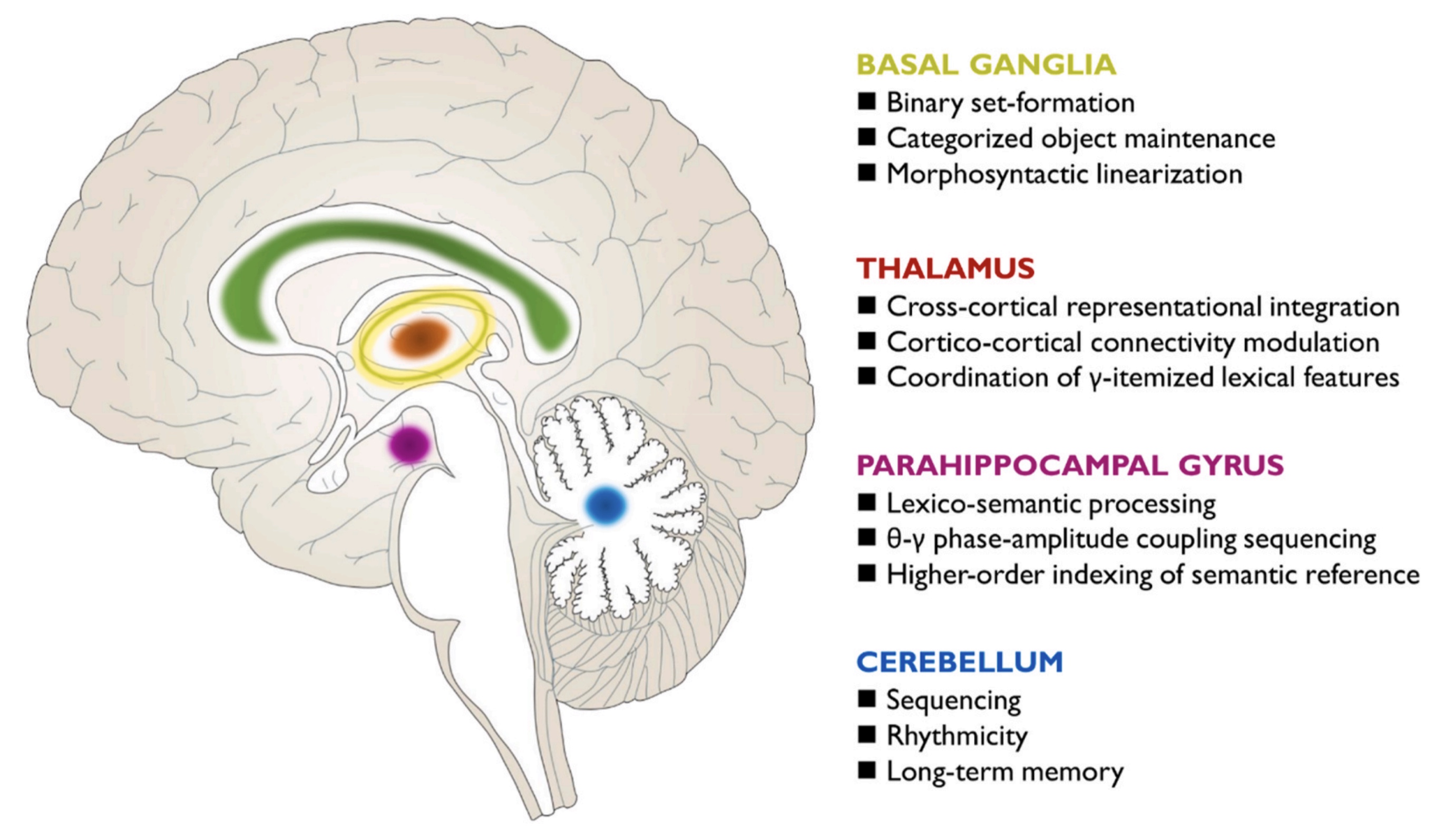
I have written a review of subcortical contributions to higher cognition, arguing for the need to move beyond some of the classical ‘cortico-centric’ models of cognition.
• Murphy, E., Hoshi, K., & Benítez-Burraco, A. (2022). Subcortical syntax: reconsidering the neural dynamics of language. Journal of Neurolinguistics 62: 101062.
The neurobiological basis of language in the healthy, aging brain remains a relatively neglected topic, in particular with respect to basic aspects of grammar and meaning. I have reviewed the current state-of-the-art in research concerning how aging can result in distinct neural signatures of language. Particular focus is placed on spatiotemporal dynamics and neural oscillations, inter-brain coupling, 1/f neural noise, and neural entrainment.
• Murphy, E. (Forthcoming). Time slows down in the future: Aging and the brain rhythms of language.
A related project concerns the neurobiological basis of language deficits, which I have explored via their oscillatory and genetic basis.
• Benítez-Burraco, A., & Murphy, E. (2016). The oscillopathic nature of language deficits in autism: from genes to language evolution. Frontiers in Human Neuroscience 10: 120.
• Wilkinson, C., & Murphy, E. (2016). Joint interventions in autism spectrum disorder: relating oscillopathies and syntactic deficits. UCL Working Papers in Linguistics 28: 1–7.
• Murphy, E., & Benítez-Burraco, A. (2016). Bridging the gap between genes and language deficits in schizophrenia: an oscillopathic approach. Frontiers in Human Neuroscience 10: 422.
• Benítez-Burraco, A., Lattanzi, W., & Murphy, E. (2016). Language impairments in ASD resulting from a failed domestication of the human brain. Frontiers in Neuroscience 10: 373.
• Murphy, E., & Benítez-Burraco, A. (2017). Language deficits in schizophrenia and autism as related oscillatory connectomopathies: an evolutionary account. Neuroscience & Biobehavioral Reviews 83: 742–764.
Moving to other domains of cognitive neuroscience, I have investigated via intracranial recordings the cortical signatures of category-selective visual attention (In prep) and concreteness (In prep). I have also explored how linguistic pragmatics and visual attentional processes both appear to construct representations based on factors such as salience, prominence and accessibility.
• Murphy, E. (2016). A pragmatic oscillome: aligning visual attentional mechanisms with language comprehension. Frontiers in Systems Neuroscience 10: 72.

I am leading a number of other current projects using intracranial recordings to chart various components of cognition and structure-building.
Contributions to Political Philosophy and Ethics
My contributions to political philosophy and ethics have focused on the interface between radical political thought and strands within philosophy of science that could be argued to be rooted in sympathetic principles. I have not followed here the more standard Marxist approach of connecting science and materialist visions of history, but have rather been more engaged in drawing some connections between progressive left-libertarian and classical liberal philosophers and perspectives on the scientific method. For example, though it is still largely regarded as a wholly political tendency, anarchism has long enjoyed a close relationship with the sciences. This project also involved exploring to what extent our current understanding of the brain can inform theories of political action.
• Murphy, E. (2019). Anarchism and science. In Levy, C. & Adams, M.S. (eds.), The Palgrave Handbook of Anarchism. Palgrave Macmillan. 193–209.
Overlapping with my interests in literary criticism, my book Unmaking Merlin documented how various traditions in radical politics have inspired some of the English language’s most revered, and reviled, authors.
• Murphy, E. (2014). Unmaking Merlin: Anarchist Tendencies in English Literature. London: Zer0 Books.

My book on the political economy of the modern UK defence industry extensively investigated the financial ties (i.e., investments and consulting) many academic institutions, museums and quasi-public bodies have with arms manufacturers, exploring the motivations and implications of this.
• Murphy, E. (2016). Made in Britain. London Review of Books. 13 January.
• Murphy, E. (2020). Arms in Academia: The Political Economy of the Modern UK Defence Industry. London: Routledge.

One core theme of my research in political philosophy has been economic democracy. My latest book reviews alternative models of economic ownership, such as worker co-operatives and public banks, exploring economically feasible replacements for traditional capitalist firms and management.
• Murphy, E. (In prep). Frameworks of Freedom: Experiments in Economic Democracy and Worker-Owned Enterprise.
Lastly, a somewhat less somber topic I have explored is the way in which video games communicate – via modes unique to this format – radical political critiques.
• Murphy, E. (2015). Video games and radical politics. Los Angeles Review of Books. 9 August.

I have written for publications such as Jacobin, Tribune, Novara Media, Declassified UK, OpenDemocracy, Ceasefire Magazine and the London Review of Books on various literary, philosophical, economic and human rights issues.
Overall, my research in political philosophy began with more philosophical and ideological investigations, but is progressing towards exploring models of economic ownership and alternative structures for democratic and workplace organization.
 Elliot Murphy
Leave a comment