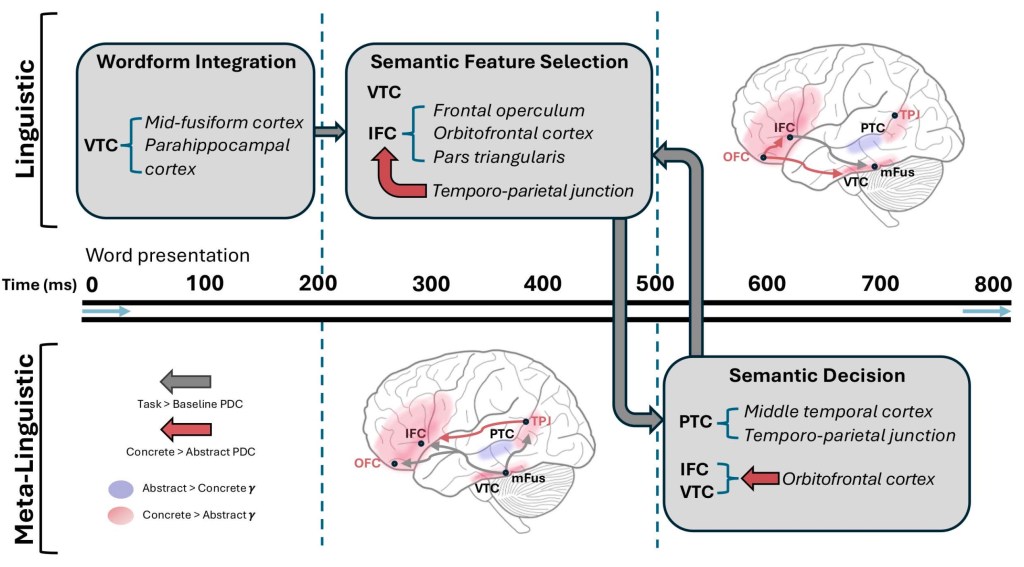
New intracranial EEG paper published in PLOS Biology, exploring single-word concreteness judgments during reading [PDF]:
“Neurobiological models of conceptual processing have been limited in spatiotemporal resolution, and uncertainty remains about the causal role of specific regions in concept representation. We utilized intracranial recordings in human neurosurgical patients with epilepsy (n = 19) during a concreteness judgement paradigm of single word reading. Concrete concepts showed greater high-frequency activation across a frontal and ventrotemporal network, while greater activation for abstract words was found in lateral posterior middle temporal cortex. Intercortical communications, measured by high-frequency partial direct coherence, revealed bidirectional frontal and ventral plus lateral temporal interactions. Words occupying the middle range of the concreteness scale (e.g., “profit”) activated similar regions, but high-frequency signatures were not modulated by the participants’ semantic decisions about these words. Cortical stimulation of ventrotemporal cortex and inferior frontal cortex disrupted the ability to make concreteness judgements. These results suggest that semantic information is encoded via a causally directed system of bidirectional cortical cascades: early visual-linguistic integration in ventrotemporal cortex initiates directed information flow to frontal hubs, and later processing shows reciprocal flow back to ventral and lateral temporal regions integrating distinct conceptual features, with these convergence zones differing based on semantic type. Our results provide a systems-level account for how the human brain transforms word forms into grounded conceptual meaning that is invariant of subjective judgment.”
 Elliot Murphy
Leave a comment